What the Development Support Programme Is
A government revenue programme that grants citizenship in return for a non-refundable contribution to the treasury.
Vanuatu's Development Support Programme (DSP) is a legal path to citizenship, established under the nation's Citizenship Act [CAP 112]. It's straightforward. Foreign nationals can obtain a passport by making a significant, non-refundable financial contribution to a government development fund. The Vanuatu Citizenship Commission runs the programme and insists that every applicant passes a strict due diligence process before getting the green light.
Don't confuse the DSP for citizenship with the "Development Support visa." That's a completely separate category for foreign workers on specific government projects. The programme detailed here leads directly to citizenship and a passport.
What Are the Core Requirements for the Vanuatu DSP?
To qualify for citizenship through the Development Support Programme, every applicant has to meet a clear set of financial and personal criteria. The entire process is designed to ensure new citizens are of good character and have contributed meaningfully to Vanuatu's economy.
Financial Contribution
The main requirement is a non-refundable contribution to the government's development fund. As of 2026, the minimum contribution starts at US$80,000 for a single applicant, although agents often package total costs differently. This amount climbs for families. A married couple typically needs to contribute US$100,000, while a family of three (a couple with one child) will be around US$115,000.
Applicant Eligibility
Every applicant undergoes rigorous vetting. The main applicant must be over 18, in good health, and prove they have a clean criminal record with no outstanding warrants. The application can also cover dependants—a spouse, children under 18, and sometimes even adult children (usually 18-25 if they are full-time students and financially dependent) or dependent parents over 50.
Due Diligence
Due diligence is the mandatory, thorough cornerstone of the DSP. In fact, before you even make the main contribution, you must pay a non-refundable due diligence fee, which is typically US$5,000 per application. This covers the background checks performed by Vanuatu's Financial Intelligence Unit (FIU) and its partners. Expect to provide extensive documentation proving your identity, character, and—most critically—the legal source of your funds.
How Does the DSP Application Process Work?
The application process for the Development Support Programme is structured and must be followed exactly. You cannot apply directly. It is managed exclusively through government-authorised agents.
Step 1: Engage an Authorised Agent
Your first step is the most critical: engage an agent who is officially authorised by the Vanuatu Government to handle DSP applications. There aren't many. Working with an unauthorised party is a fast track to financial loss and a rejected application. The agent’s job is to build your application file, give advice on documents, and serve as the sole link to the Vanuatu Citizenship Commission.
Step 2: Initial Due Diligence Submission
The process kicks off with a preliminary check. Your agent submits initial documents, like certified copies of your passport and a police clearance certificate, to Vanuatu's Financial Intelligence Unit (FIU). This allows for a basic background check. If this stage fails, the process stops here, preventing you from investing more time and money into a doomed application. Only after passing can you proceed.
Step 3: Full Application and Commission Review
Once the FIU check clears, your agent compiles the complete application file. This is a mountain of paperwork: birth certificates, marriage certificates, detailed source-of-funds evidence, bank references, professional references, and medical declarations for everyone on the application. This full dossier then goes to the Citizenship Commission, which reviews the case and makes the final decision.
Step 4: Approval, Payment, and Oath of Allegiance
If the Citizenship Commission approves your application, it issues an "approval-in-principle" letter. This isn't the end. Upon receiving this letter, you must transfer the full contribution amount to the designated government account. After the government confirms the funds have landed, the final step is taking the Oath of Allegiance. This can often be done in various locations worldwide, so you don't necessarily have to travel to Vanuatu. Once the oath is taken, the Certificate of Naturalisation is issued, and you can apply for your Vanuatu passport.
What Are the Key Costs and Fees Involved?
The total cost of DSP citizenship is more than just the headline contribution number. You have to budget for several other government and professional fees.
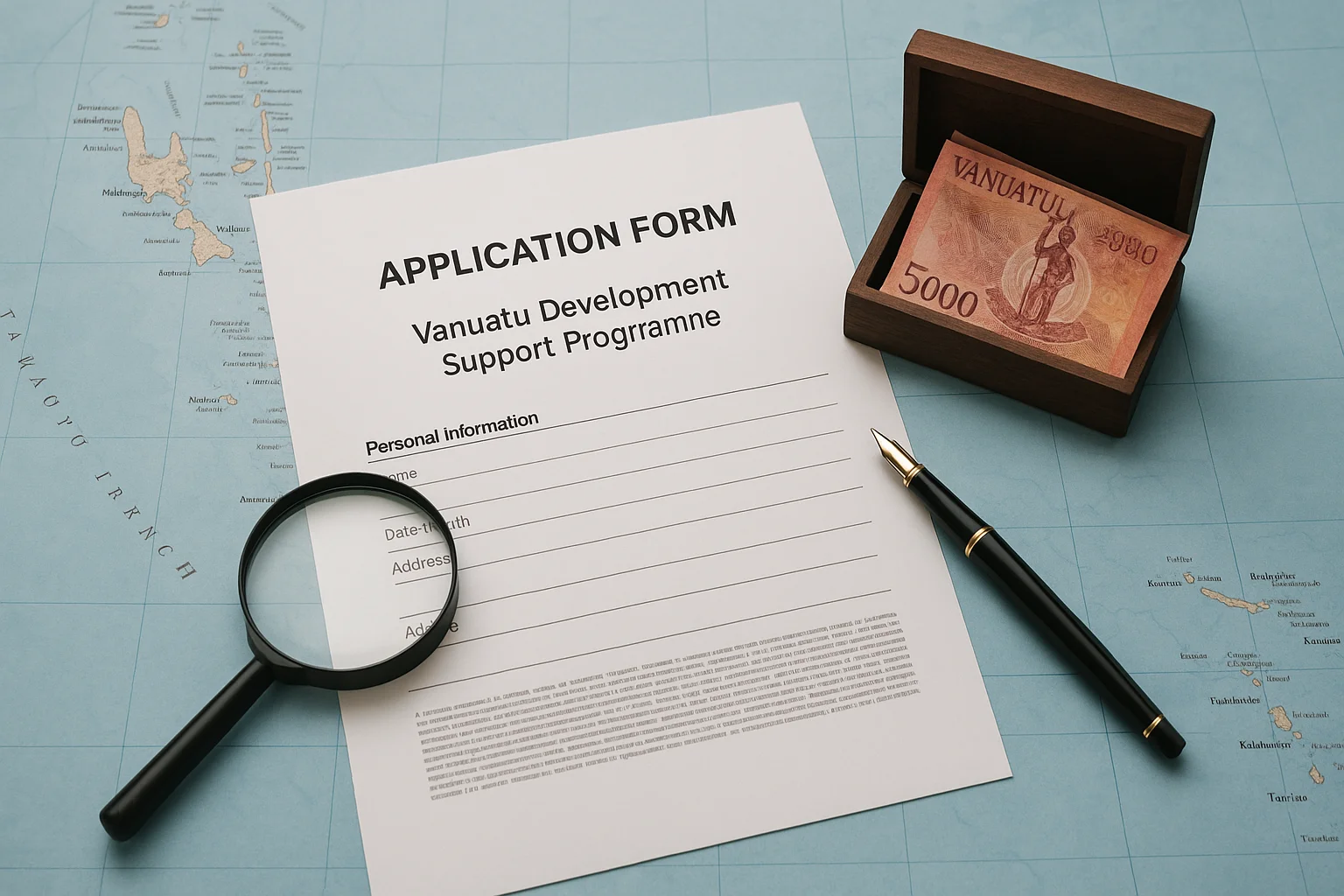
- The Contribution Amount: This is the big one. The minimum non-refundable donation is US$80,000 for a single applicant, rising to US$100,000 for a couple, and US$115,000 for a family of three. These are base amounts that go up with each extra dependant.
- Due Diligence & Application Fees: At the start of the process, you'll pay separate, non-refundable fees. The statutory application fee is a nominal VT 5,000 per application, but the significant cost is the due diligence fee—typically US$5,000—which pays for the government's extensive background checks.
- Agent and Other Professional Costs: Your authorised agent charges a professional fee for their service, which can vary significantly. This fee covers the immense work of preparing, checking, and submitting your file and coordinating the final steps. You might also face smaller costs for things like document certification, translation, and passport issuance.
What Documents Are Required for the DSP Application?
A successful application hinges on a complete and impeccably organized set of documents. Even a small error—a missing paper or an inconsistent detail—can cause major delays or even rejection.
Personal Identification
The file's foundation is your core identity documents. This means high-quality, certified true copies of current passports for all applicants, plus any recently expired ones. Certified copies of national ID cards and full birth certificates are also mandatory for every single person included in the application.
Character and Background Verification
You must prove you are of good character. This demands original police clearance certificates from your home country and any other country where you've lived for more than a year in the last decade. A detailed Curriculum Vitae (CV) for the main applicant is also required to paint a complete personal and professional history.
Financial and Medical Evidence
This is where the scrutiny is most intense. You have to provide comprehensive evidence detailing where the money for your contribution came from. This could be business ownership documents, employment contracts, property sale agreements, or inheritance records. You will also need a professional reference (from a lawyer or accountant) and a bank reference letter. Finally, a simple medical declaration or certificate confirming all applicants are in good health is a standard part of the checklist.
What Are the Common Pitfalls and Reasons for Delays?
Vanuatu's DSP is known for being efficient, but several common mistakes can easily derail an application. Knowing these risks is the key to a smooth journey.
Using Unauthorised Agents
The single biggest risk is dealing with someone not officially authorised by the Vanuatu government. The government publishes a list of authorised agents. Check it. Using an unauthorised intermediary is the number one cause of fraud and failed applications.
Incomplete or Inconsistent Documentation
Simple paperwork errors cause the most frequent delays. Submitting documents that aren't properly certified, forgetting a police certificate from a country you lived in five years ago, or having inconsistencies in names or dates across different papers—all of these will halt your application. Every document must be perfect and consistent.
Insufficient Source-of-Funds Evidence
Vanuatu’s due diligence team cares deeply about the legitimacy of your wealth. Providing a clear, documented, and verifiable trail for the funds is non-negotiable. Vague explanations, gaps in your financial history, or weak claims about where your money came from are major red flags. They are a common reason for refusal.
Misunderstanding Processing Times
The DSP is one of the world's fastest citizenship by investment programmes, and agents often market a timeline of 1-3 months. It's achievable, but see it as an estimate, not a promise. There are no fixed statutory decision deadlines. This means your actual processing time can stretch longer depending on the complexity of your case, the clarity of your documents, and the current workload at the Citizenship Commission and FIU.
This article is published by an independent law firm for informational purposes only and does not represent or claim affiliation with any government body, international organization, or official authority.
Questions
Frequently Asked Questions
The minimum cost for a single applicant under the Development Support Programme is a US$80,000 non-refundable contribution to the government. On top of that, you will pay a non-refundable due diligence fee of about US$5,000 plus agent fees. For families and additional dependants, the total cost increases.
A Vanuatu passport offers several advantages. The biggest is visa-free travel to over 95 countries, though this list can and does change. Vanuatu also provides a favourable tax environment for residents, with no personal income tax, wealth tax, or inheritance tax. The programme is also known for being one of the fastest of its kind in the world.
No, you can't simply "buy" a passport. That's a common misconception. The process is actually about acquiring citizenship first, through a legal framework called the Development Support Programme (DSP). It requires a significant economic contribution to the country's development fund and passing stringent background checks. Only after you are granted citizenship do you become eligible to apply for a Vanuatu passport, just like any other citizen.
While often advertised as one of the fastest citizenship by investment routes—with timelines around 1 to 3 months—that's an optimistic estimate. The real timeline can stretch. A simple mistake on your application can send it to the back of the queue, and complex personal or financial histories naturally require deeper, longer due diligence. The caseload of the Vanuatu Citizenship Commission also plays a huge role; a surge in applications can create a bottleneck, so it's wise to build a buffer into your personal and business planning. { "@context": "https://schema.org", "@graph": [ { "@type": "
Contact Us
Schedule Your Free Case Evaluation Today
Share the details of your situation with our team, and we'll provide a prompt, confidential response. We're here to listen, answer your questions, and help you understand your legal options.
Send Us a Message
Reach Us Directly
All consultations are strictly confidential and protected by legal professional privilege.