What the Numbers Show
Published figures on grants and revenue, and the caution needed when reading them.
Just 27 rejections. Out of 1,988 applications processed between 2022 and 2023, Vanuatu's citizenship by investment programmes approved almost every single one. This translates to an astonishingly low rejection rate of 1.36%. These official figures, released during the country's tense dialogue with the European Union, also show that since the programme's inception in 2015, over 10,500 passports have been issued to foreign investors and their families.
These numbers paint a picture of a high-volume, highly predictable programme. But they're also the exact reason for intense international scrutiny. Deep concerns over due diligence standards triggered the European Union to suspend its coveted visa-waiver agreement with Vanuatu, gutting the travel benefits of its passport. This article breaks down the official statistics, explains your investment options, details the critical legal challenges facing the programme, and outlines the application process for prospective investors in 2026.
What Do the Official Application and Approval Numbers Reveal?
Data provided by Vanuatu to the European Union confirms a high-throughput operation. Between 2022 and 2023 alone, authorities processed 1,988 applications under the country's citizenship by investment (CBI) schemes, underscoring the massive demand for Vanuatu's passport among global investors.
Of these nearly two thousand applications, almost none were denied. Only 27 rejections were recorded, putting the programme's rejection rate at a mere 1.36%. For an applicant, this suggests a very predictable outcome. For international bodies like the EU, however, this low rate became a red flag, sparking questions about the rigour of the security and background checks being applied.
Looking at the long-term numbers is even more revealing. A European Commission report confirmed that by March 2021, Vanuatu had already issued over 10,500 passports through its investor schemes. This output has created a vital source of non-tax revenue for the Vanuatu government. But it has also brought a storm of negative attention, centered on the potential for security risks among third-country nationals gaining a Vanuatu passport.
How Has the EU Responded to Vanuatu's CBI Program?
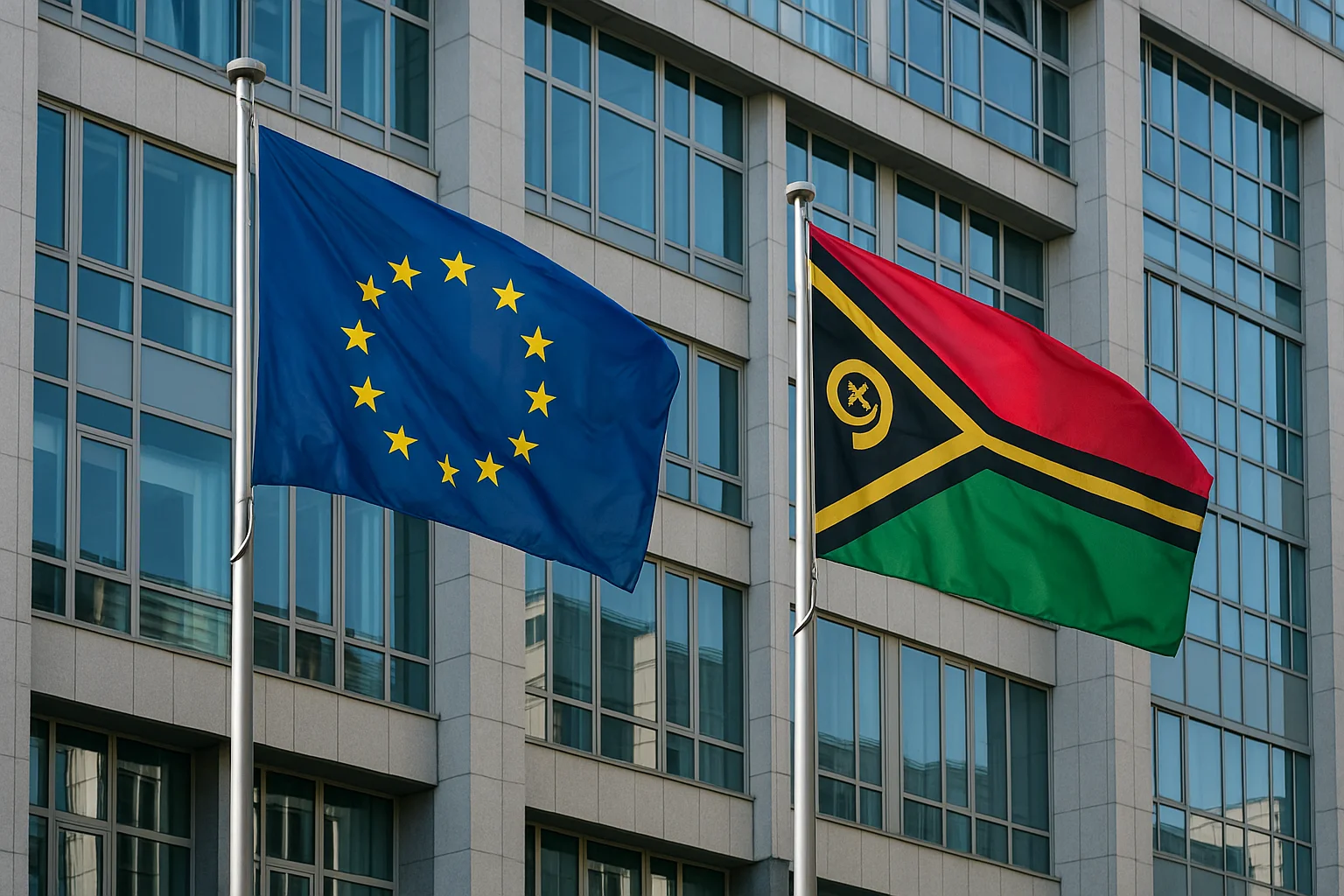
The European Union's response has been decisive. Citing security risks posed by Vanuatu's CBI programmes, it took the most significant action possible: suspending the visa-waiver agreement that allowed Vanuatu citizens visa-free travel to the Schengen Area. The suspension began on 4 February 2023 and is currently set to last until at least 3 August 2024, creating a period of major uncertainty for passport holders and new applicants.
The legal basis for this move is Article 8 of Regulation (EU) 2018/1806, which allows for a visa-suspension mechanism. The EU's primary fear, laid out in official documents, is that the CBI programmes offer a backdoor into the Schengen Area for individuals who might not pass the robust security screening required for a regular visa, thus posing a risk to member states' internal security.
The situation has only worsened. After the temporary suspension, the European Commission issued a formal proposal, COM(2024) 365, to make Vanuatu's removal from the visa-exempt list permanent. If the EU Council adopts this, it would permanently strip the Vanuatu passport of its most powerful travel benefit, dramatically devaluing it for anyone whose goal is global mobility.
Timeline of Key Events
- 25 May 2015: Vanuatu officially launches its investor-citizenship schemes.
- 4 May 2022: A partial suspension of the EU visa waiver kicks in, specifically targeting passport holders who gained citizenship after 2015.
- 4 February 2023: The axe falls. A full suspension of the visa waiver agreement begins, affecting all Vanuatu passport holders, new and old.
- 3 August 2024: The current suspension is scheduled to end. This date is critical, as the EU will either extend the suspension, end it, or make the ban permanent, creating a make-or-break moment for the program's value.
What Are the Current Investment Options for Vanuatu Citizenship?
For investors seeking Vanuatu citizenship, the most direct path is a non-refundable contribution to a government fund. While other theoretical options exist, the donation route is the most established, predictable, and widely used.
Investment Option 1: The Development Support Program (DSP)
This is the workhorse of Vanuatu's CBI. It involves a one-time donation to a government fund established to support national development projects. The minimum contribution for a single applicant is $130,000. This cost rises for families, usually starting at $150,000 for a main applicant and spouse, with additional fees for dependent children or parents.
Investment Option 2: Approved Real Estate Projects (Currently Limited)
The law has historically allowed for an investment in government-approved real estate to qualify for citizenship. In practice, this option has been rare and depends entirely on whether any projects are currently approved and active. Investors must be extremely cautious and verify the official status of any real estate project with a designated agent before committing funds.
Investment Option 3: The Cocoa Sustainable Fund (CSF) - A New Development
Vanuatu recently introduced an "in-kind" contribution option through the Cocoa Sustainable Fund. This pathway allows for a non-financial contribution to a commodity fund. While it's presented as an alternative to the cash donation, its market adoption, processing times, and real-world efficiency are still largely unproven.
What Are the Eligibility and Documentation Requirements?
To qualify, you must meet a clear set of criteria designed to filter for good character and legitimate financial standing. The main applicant must be over 18, hold a clean criminal record, and be able to prove the lawful source of their investment funds.
Main Eligibility Criteria:
- Age: The main applicant must be between 18 and 65 years old.
- Financial Standing: You must show proof of a net worth of at least $250,000. Crucially, you must also provide a clear paper trail for the source of the funds used for the investment.
- Due Diligence: Every applicant undergoes a comprehensive background check by Vanuatu's Financial Intelligence Unit (FIU) and authorized third-party agencies. This mandatory screen looks for criminal records, international sanctions, and politically exposed person (PEP) status.
Required Documents:
- Certified copies of your current passport and national ID.
- Police clearance certificates from your country of origin and any other country where you've lived for more than one year in the last decade.
- A detailed Curriculum Vitae (CV) covering your professional and personal background.
- Substantial proof showing the source of your investment funds. This is a common point of delay, so meticulous preparation is key.
- A medical certificate confirming good health for you and any included dependents.
- Completed application forms and identity documents (like birth or marriage certificates) for everyone on the application.
What is the Step-by-Step Application Process?
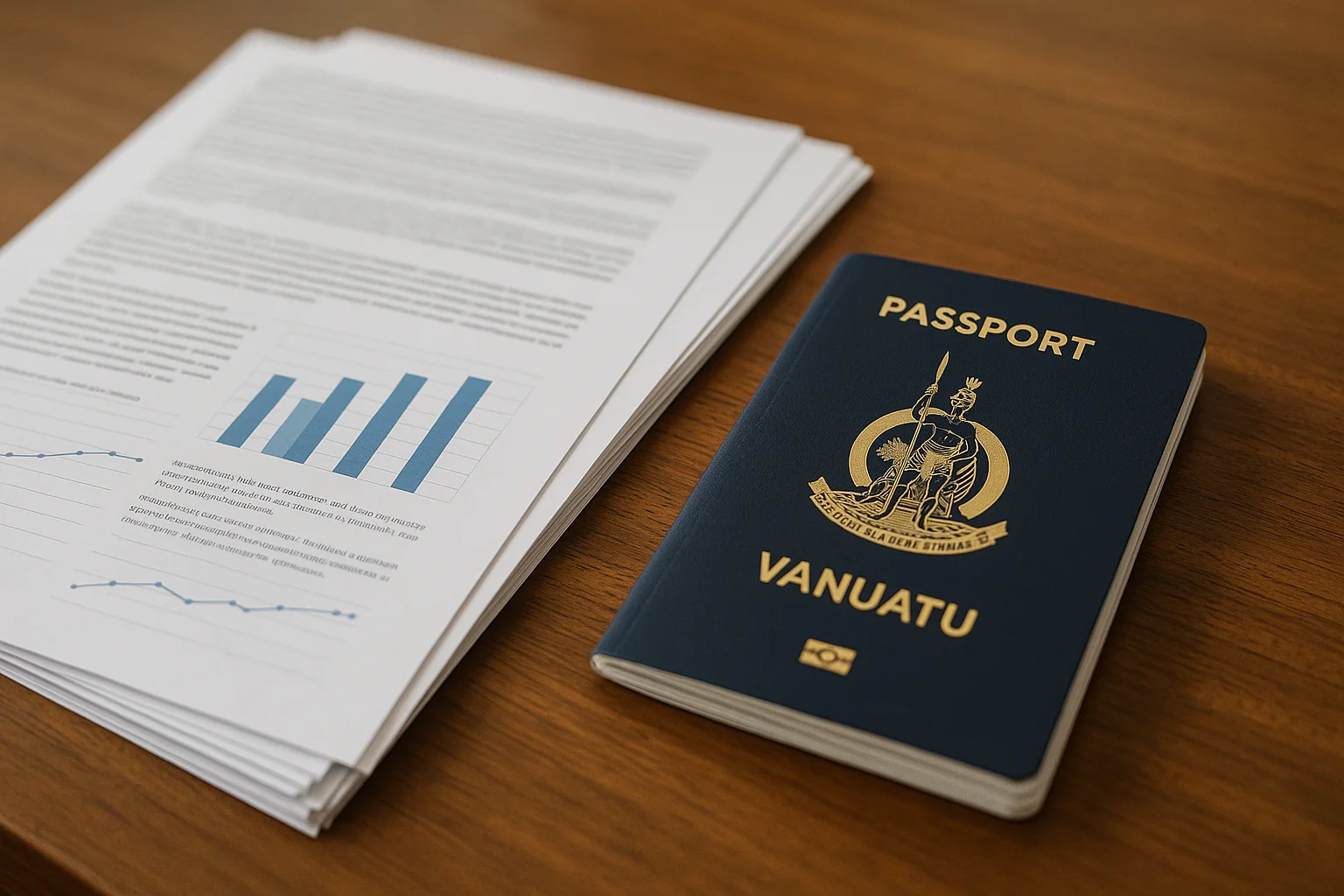
Vanuatu's CBI process is famous for its speed, with a typical timeline of 2 to 3 months from submission to holding a passport. The process is rigid and must be handled by a government-appointed designated agent.
Step 1: Initial Due Diligence & Agent Appointment
You cannot apply directly. Your first step is to hire a designated agent, who will conduct a pre-screening to flag any potential red flags early on and help you gather the initial documents.
Step 2: Financial Intelligence Unit (FIU) Check
The process officially starts when you pay the FIU due diligence fee (around $5,000) and submit a preliminary application. The FIU then runs its background check. An issue here, such as an old, undisclosed legal problem, can kill the application before it truly begins. A successful check yields a clearance letter, green-lighting the next stage.
Step 3: Full Application Submission
With FIU clearance, your agent assembles the complete application file with all supporting documents and submits it to the Vanuatu Citizenship Commission. At this stage, you're required to pay 25% of the total donation amount.
Step 4: Final Approval and Investment
The Citizenship Commission does a final review. If everything checks out, it issues an "Approval in Principle" letter. This is your official confirmation of approval, contingent on making the full investment. You then transfer the remaining 75% of the donation amount.
Step 5: Oath and Passport Issuance
Once the government confirms receipt of the final payment, a Certificate of Naturalization is issued in your name. The last hurdle is taking an Oath of Allegiance. This can often be done conveniently at a Vanuatu consulate or even remotely. After the oath, your Vanuatu passport is printed and issued.
This article is published by an independent law firm for informational purposes only and does not represent or claim affiliation with any government body, international organization, or official authority.
Questions
Frequently Asked Questions
The starting point is a $130,000 non-refundable donation to the Development Support Program for a single applicant, which increases for a family. However, you must also budget for due diligence fees, application processing costs, and agent service fees, which will raise the total all-in cost significantly.
Several nations, mostly in the Caribbean, have well-established citizenship by investment programs. The most popular include St. Kitts & Nevis, Grenada, Dominica, St. Lucia, and Antigua & Barbuda. Outside the Caribbean, Malta offers a pathway to citizenship for exceptional services by direct investment.
For its citizens and residents, Vanuatu has a highly favourable tax regime. It imposes no personal income tax, no wealth tax, no inheritance tax, and no capital gains tax. This "tax neutrality" is a primary draw for investors looking to legally optimize their global tax burden.
What makes a citizenship "valuable"? It's personal. Your priorities define the answer. If pure visa-free travel is your goal, passports from places like Japan, Singapore, and Germany consistently top the rankings. For investors, though, the calculation changes. The best passport might be the one that balances travel freedom with low taxes, fast processing, and a reasonable investment cost. Vanuatu is a case in point: while its passport has lost its EU visa-waiver status—meaning you'll now need a separate Schengen visa for Europe—it still offers visa-free entry to roughly 89 o
Contact Us
Schedule Your Free Case Evaluation Today
Share the details of your situation with our team, and we'll provide a prompt, confidential response. We're here to listen, answer your questions, and help you understand your legal options.
Send Us a Message
Reach Us Directly
All consultations are strictly confidential and protected by legal professional privilege.