The Citizenship Commission
Composition, powers and the point at which an application becomes a decision.
Thinking about Vanuatu citizenship? Smart. Your first step is to understand the official gatekeeper: the Vanuatu Citizenship Commission. This is the government body that reviews, processes, and ultimately decides on every single application, including those from investment programs like the Development Support Program (DSP). It operates under Vanuatu's Citizenship Act [Cap 112] and has the final say on granting or refusing citizenship. This guide cuts through the sales pitches to give you a fact-based overview of the Commission's role, the legal framework, and exactly what's required from investors.
The promise is speed. Vanuatu does have one of the fastest citizenship by investment programs globally, offering a passport with significant visa-free access. But that speed depends on precision. Understanding the formal role of the Citizenship Commission—separate from any marketing agent you talk to—is the first critical step for any applicant. This article explains the official procedure, not the marketing fluff.
What is the Legal Role of the Vanuatu Citizenship Commission?
Make no mistake: the Citizenship Commission is a gatekeeper, not a salesperson. Established by Vanuatu’s Constitution and the Citizenship Act [Cap 112], it is the sole legal authority for granting, depriving, or making any decision on citizenship. It’s a regulatory body, not a promotional agency, tasked with one thing: upholding the integrity of Vanuatu citizenship. The Commission is composed of a Chairman and members appointed by the President, and it works with the Vanuatu Citizenship Office and the Citizenship Investment Migration Unit (CIMU). Its decisions are based on a strict legal framework. This means your application isn't a negotiation; it either meets the legal standard, or it fails.
The Citizenship Act [Cap 112]
The Citizenship Act [Cap 112] is the bedrock of Vanuatu citizenship law. It defines who is a citizen, how citizenship can be acquired—whether by birth, descent, naturalisation, or investment—and the conditions under which it can be revoked. Every power the Citizenship Commission wields comes directly from this act. It's the ultimate source of truth for all citizenship routes.
The Development Support Program (DSP) Regulations
While the Citizenship Act provides the legal foundation, government regulations create the practical path for investors. The Development Support Program (DSP) was created by specific government regulations (Order No. 215 of 2016 and subsequent amendments). These orders spell out the exact investment amounts, procedures, and requirements the Citizenship Commission must follow when evaluating applications under this popular route. For nearly every investor in 2026, the DSP is the legal mechanism they will use.
How Does the Official Application Process Work?
Here's a critical point most people miss: you cannot apply directly to the Citizenship Commission. The law is explicit. All applications must be submitted through a government-designated agent. This agent is your official intermediary, responsible for assembling your file and lodging it correctly with the Citizenship Office/CIMU. Trying to sidestep this requirement or using an unapproved fixer is a guaranteed way to fail, and likely lose your money.
Step 1: Appointing a Designated Agent and Initial Checks
Your first move is choosing a designated agent who is officially authorised by the Vanuatu government—the government maintains a public list for this very purpose. The agent's job is to conduct preliminary checks, confirm your eligibility, and guide you through the collection of the massive amount of paperwork needed for a compliant file. A good agent will spot potential problems before you even start.
Step 2: Document Compilation and FIU Clearance
The agent builds your complete application file based on the government's official checklist. Once it's ready, the agent lodges it with the government and pays the initial, non-refundable 5,000 Vatu application fee.
Your file is then sent to the Vanuatu Financial Intelligence Unit (FIU). This is where the real scrutiny begins. The FIU performs a deep due diligence check on you and any dependents on the application. It's a mandatory, non-negotiable step. The FIU must give a green light before anything else can happen. A red flag from the FIU stops the entire process cold.
Step 3: Commission Review and Decision
With FIU clearance in hand, your complete file is formally presented to the Citizenship Commission. The Commission meets to review the application and renders its final judgment. There are only three possible outcomes:
- Approve: The application is clean and meets all requirements.
- Defer: The Commission needs more information or clarification on a specific point. This isn't a rejection, but it does mean more work and delays.
- Refuse: The application is denied. This can happen due to ineligibility, a failed due diligence check, or discovering you provided false information.
Step 4: Approval, Investment, and Oath
Once you receive an "Approval in Principle" from the Commission, you'll be instructed to make the full donation for the Development Support Program. After your payment is confirmed, the clock starts ticking. You have a strict 3-month window to take the Oath of Allegiance and pay the citizenship certificate fee. If you miss this deadline, your approval could be voided, forcing you to restart the process and potentially forfeiting your investment.
Step 5: Receiving Your Citizenship Certificate and Passport
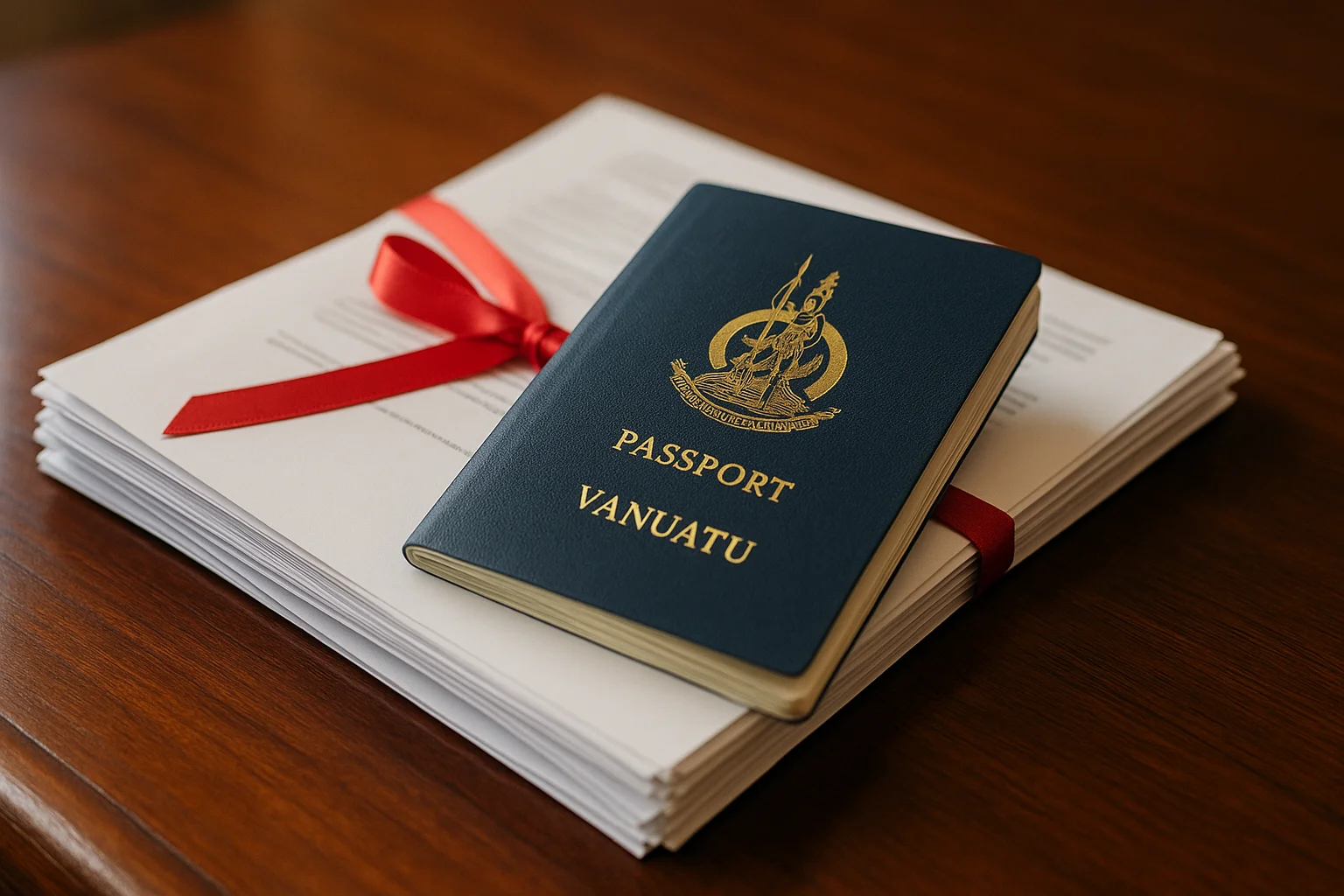
After taking the Oath of Allegiance, the Citizenship Commission issues your official Certificate of Naturalization. This document is the legal proof that you are now a citizen of Vanuatu. Only with this certificate can you then apply for your Vanuatu passport through the national passport office.
What Documents Will the Commission Expect to See?
The Commission demands a comprehensive set of documents to verify who you are, where your money comes from, and your character. Your agent will give you the exact checklist, but you can expect to provide:
- Personal Documents: Certified copies of all current passports, birth certificates, national ID cards, and your marriage certificate, if applicable.
- Financials: You need detailed proof of funds for the investment and fees, plus clear evidence showing the legal source of those funds. Bank statements for the last six months are almost always required.
- Security Checks: Police clearance certificates from your country of origin and any other country where you’ve lived for more than a year in the last five years.
- Other Paperwork: A medical certificate confirming good health, a detailed CV, and professional references. Getting a complete document checklist for Vanuatu citizenship from your agent is non-negotiable.
How Much is Citizenship by Investment in Vanuatu?
The baseline investment is a US$130,000 non-refundable contribution for a single applicant under the Development Support Program (DSP). This minimum increases with each family member you add. Critically, these are just the government contribution amounts—they don't include all the other required fees.
The government-mandated DSP contributions are:
- Single Applicant: US$130,000
- Main Applicant and Spouse: US$150,000
- Main Applicant, Spouse, and one Dependent: US$165,000
- Main Applicant, Spouse, and two Dependents: US$180,000
These figures are always subject to change by government regulation. You must verify the current amounts with your designated agent before starting.
What are the mandatory government fees?
Beyond the main donation, you must budget for several other non-negotiable government fees paid at various stages.

- Due Diligence Fee: Government regulations mandate a USD 2,000 fee for the background check conducted by the Financial Intelligence Unit (FIU). This fee is charged for the main applicant and every dependent included in the application.
- Application Fee: A small fee of 5,000 Vatu (around US$45) is paid per application upon initial submission.
- Certificate Fee: After approval, there is a separate fee for issuing the official Certificate of Naturalization.
What other costs should you budget for?
Besides government-mandated amounts, you'll have other expenses to see the process through.
- Agent Fees: This is what you pay your designated agent for their work preparing, submitting, and managing your application. Fees vary significantly between firms.
- Ancillary Costs: Don't forget the small things that add up. Budget for bank transfer fees, document translation and notarization, international courier charges for your sensitive documents, and the final passport issuance fee.
What are the Key Benefits and Potential Pitfalls?
A Vanuatu passport offers extensive visa-free travel and a highly attractive tax environment. Yet, applicants must be aware of simple procedural mistakes that can cause an application to be refused, leading to frustration and financial loss.
The Advantages of Vanuatu Citizenship
For international investors and their families, Vanuatu citizenship provides several powerful benefits.
Global Mobility
A Vanuatu passport gives you visa-free or visa-on-arrival access to over 95 countries. While visa pacts can and do change, this access typically includes key business and travel destinations like Hong Kong and Singapore, representing a major upgrade in travel freedom for many people.
Favorable Tax Environment
Vanuatu is famous for its tax laws. The country has no personal income tax, no wealth tax, no inheritance tax, and no capital gains tax. This applies to all citizens, whether they live in Vanuatu or not, making it a powerful tool for wealth preservation and tax planning.
Speed and Simplicity
The Vanuatu program is known for its remarkable efficiency. From submitting a complete file to final approval, the official timeline is typically one to three months. It's one of the fastest citizenship by investment programs on the planet. The process is also quite straightforward, with clear, legally defined requirements.
Common Pitfalls to Avoid
The process may be fast, but it is also brutally strict. Certain mistakes can kill an application instantly.

Using Unauthorized Intermediaries
The number one reason for failed applications and lost money is working with people or companies not on the government's official list of designated agents. Only these designated agents have the legal right to submit an application. Anyone else claiming they can is operating outside the law, and any money paid to them is at extreme risk of being lost forever.
Incomplete or Falsified Information
Make no mistake: the Citizenship Commission and the Financial Intelligence Unit conduct intensely rigorous, multi-layered due diligence. Any discrepancy, omission, or outright lie in the application will be found. This leads to one outcome. Immediate refusal. A final one. It could even get you barred from ever reapplying. Worse, if citizenship is granted based on false information that surfaces later, the government can—and will—revoke it under the Citizenship Act.
Missing the Post-Approval Deadline
After receiving your Approval in Principle, a strict 3-month deadline to take the Oath of Allegiance starts ticking. Missing this deadline can nullify the entire process. This isn't a soft target; the government is not obligated to offer an extension, and a failure here means forfeiting any funds already paid and starting the entire, expensive application from scratch. You must have your travel plans ready, as a personal emergency or even a passport nearing its expiration date won't be considered a valid excuse.
How Does Vanuatu Compare to Other Citizenship Programs?
While several nations, particularly in the Caribbean, offer similar citizenship by investment programs, Vanuatu stands apart. Its unmatched processing speed and unique geopolitical footing in the Asia-Pacific region are its core advantages.
Does Antigua have citizenship by investment?
Yes, Antigua and Barbuda runs a well-established and popular citizenship by investment program. When you put it side-by-side with Vanuatu, key differences jump out. The minimum cost is often similar, though Caribbean programs can sometimes be more cost-effective for larger families. The real trade-off is in visa-free travel. While Vanuatu gets you into the UK and Hong Kong, a Caribbean passport like Antigua's typically includes visa-free access to the European Schengen Area—a benefit Vanuatu currently lacks. On the other hand, Vanuatu's processing is significantly faster than almost any Caribbean option.
Which country has the best citizenship by investment?
There is no "best" program. It's a myth. The right choice depends entirely on your personal priorities.
- If speed is everything: Vanuatu is the undisputed champion, with processing often wrapping up in just 1-3 months.
- Access to Europe: A Caribbean program from a country like St. Kitts & Nevis or Antigua is a better bet, as they usually offer visa-free access to the Schengen Area.
- For pure tax optimization: Vanuatu is a top contender. Its zero-tax regime on personal income, wealth, and inheritance is a powerful draw.
- When applying as a family: The costs can shift dramatically, so it's critical to run the numbers and compare the total fee structures of Vanuatu against several Caribbean nations.
How to get PR in Vanuatu?
It's vital to distinguish between permanent residency (PR) and citizenship. They are not the same thing. PR grants you the right to live in Vanuatu indefinitely, but it does not give you a passport or the right to vote. Citizenship is the ultimate status, granting a passport and all the rights of a natural-born citizen. The path to PR is completely separate from the investment citizenship program. It's governed by different laws and departments, usually requiring criteria like significant land ownership or proven long-term residency in the country.
This article is published by an independent law firm for informational purposes only and does not represent or claim affiliation with any government body, international organization, or official authority.
Questions
Frequently Asked Questions
The starting point is a US$130,000 non-refundable contribution to the government's Development Support Program for a single applicant. That's the base price. Expect the total to be higher after adding mandatory fees for due diligence (USD 2,000 per person), application processing, and agent fees. For a family of four, the government contribution alone rises to US$180,000 before all other costs are factored in.
The "best" program is the one that fits your specific goals. For pure speed and a zero personal tax environment, Vanuatu is often the top choice. However, if your priority is frequent, visa-free travel to Europe's Schengen Area, you would likely find a Caribbean program from Antigua or St. Kitts to be a better fit.
Permanent Residency (PR) and citizenship are two different things. PR gives you the right to live in Vanuatu, but not a passport. You'd still travel on your original passport. Getting PR involves a separate process, often tied to things like buying significant property or living in the country for a long time. It is not managed by the Citizenship Commission and is completely distinct from the citizenship by investment program.
Yes, it does. Antigua and Barbuda's program is one of the most popular in the Caribbean. It's a direct competitor to Vanuatu, but it offers a different bargain: you trade Vanuatu's incredible speed for Antigua's visa-free access to the Schengen Zone, a travel perk Vanuatu's passport does not currently offer. { "@context": "https://schema.org", "@type": "Article", "headline": "How the Vanuatu Citizenship Commission Processes an Investment Application", "datePublished": "2026-01-01", "dateModified": "2026-01-01", "author": { "@type": "Organization", "name": "vanuatucitizenshipbyinvestmentprogram
Contact Us
Schedule Your Free Case Evaluation Today
Share the details of your situation with our team, and we'll provide a prompt, confidential response. We're here to listen, answer your questions, and help you understand your legal options.
Send Us a Message
Reach Us Directly
All consultations are strictly confidential and protected by legal professional privilege.